
Your Estimate Form Isn't Getting You Leads. Here's What Is.
 8 min readNov 6, 2026
Roofers blame the quote form when leads dry up. Homeowners say they call first, check trust, and move on if nobody answers. Here is what to fix first.
Ask a roofer why the website is not bringing in jobs and you often hear the same thing. "The quote form isn't working."
So the fix becomes a new button color, a shorter form, or a different form tool. A few weeks later, nothing has changed.
That is usually the wrong place to look. The form matters less than most roofers believe. What wins the lead happens before the form and after it.
- Before: Does the homeowner call, and do they trust what they see?
- After: Does anyone reply?
Here is what the surveys say, and what to fix first.
Homeowners call first
Start with how people want to reach a roofer.
In a 2026 survey by RoofingROI Labs, 250 US adults who had hired a roofer in the past three years were asked how they preferred to make first contact. 68% said phone. Text was 14%, email 13.2%, and an online form was 4%. That is a small survey, and RoofingROI is a roofing marketing agency, so treat it as a signal and not a rule.
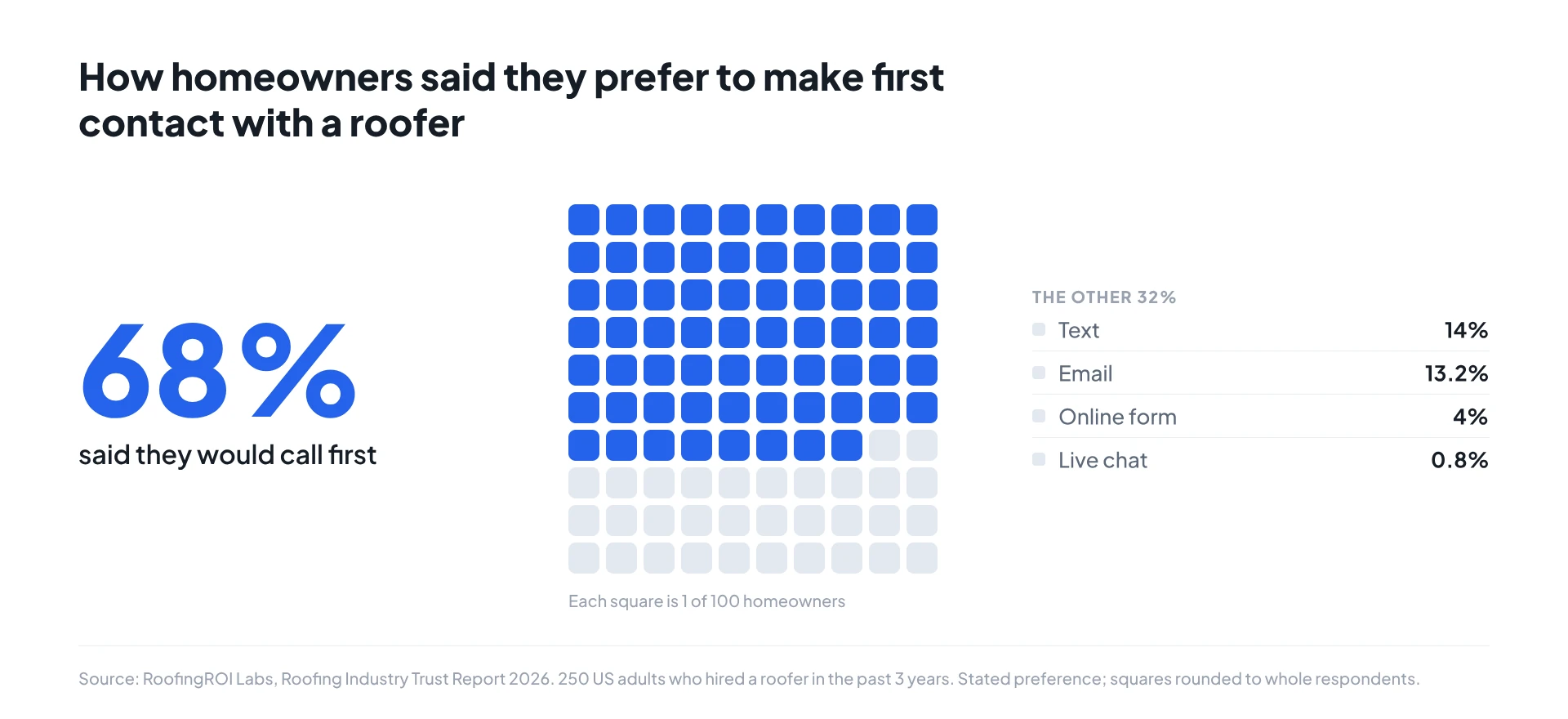
Roofing Contractor's 2026 homeowner survey, sponsored by Owens Corning, points the same way. 56% of homeowners said they prefer a phone call when they reach out to a roofer.
Both are what homeowners said, not what they did. A stated preference is also not the share of real leads that come from forms. So this does not make forms useless. It does mean the form is not the front door.
If your form is the biggest thing on the page and your phone number is small gray text in the corner, it is backwards. The number should sit at the top, large, and tappable from a phone. A homeowner standing in the driveway looking at the roof should be able to call with one tap.
Before they call, they check if you are real
A homeowner is about to let a stranger onto their roof and pay a lot of money. They look you up first.
In the same RoofingROI survey, here is what people said they check before calling:
- Google reviews: 66.4%
- The company website: 54.8%
- Years in business: 41.6%
- Photos of past work: 29.2%
- Insurance: 27.6%
When they looked at a roofer on their phone, reviews and ratings were the first thing 46.8% looked at. The tap-to-call number was first for 12.4%.
Now look at what knocks a roofer out of the running:
- Bad reviews: 72%
- No phone answer: 36%
- Few Google reviews: 32.8%
Another result in that survey shows how much review count matters. People were shown two roofers. One had 4.8 stars from 300 reviews. The other had 5.0 stars from 20 reviews. The 4.8 with 300 reviews won, 79.2% to 20.8%. And 94.8% said that seeing a completed project near them increases trust.
So a form can be perfect and still lose. If a homeowner sees few reviews, no photos of real jobs, and no sign you are local, they will not fill anything in. They will go to the next name on the list.
The survey also asked why people abandoned contact forms. The top answers were:
- Found a better option: 24.8%
- Site felt sketchy: 22.8%
- Lack of trust: 22.4%
- Too much personal information: 20.8%
- Preferred to call: 18.4%
- Form too long: 18%
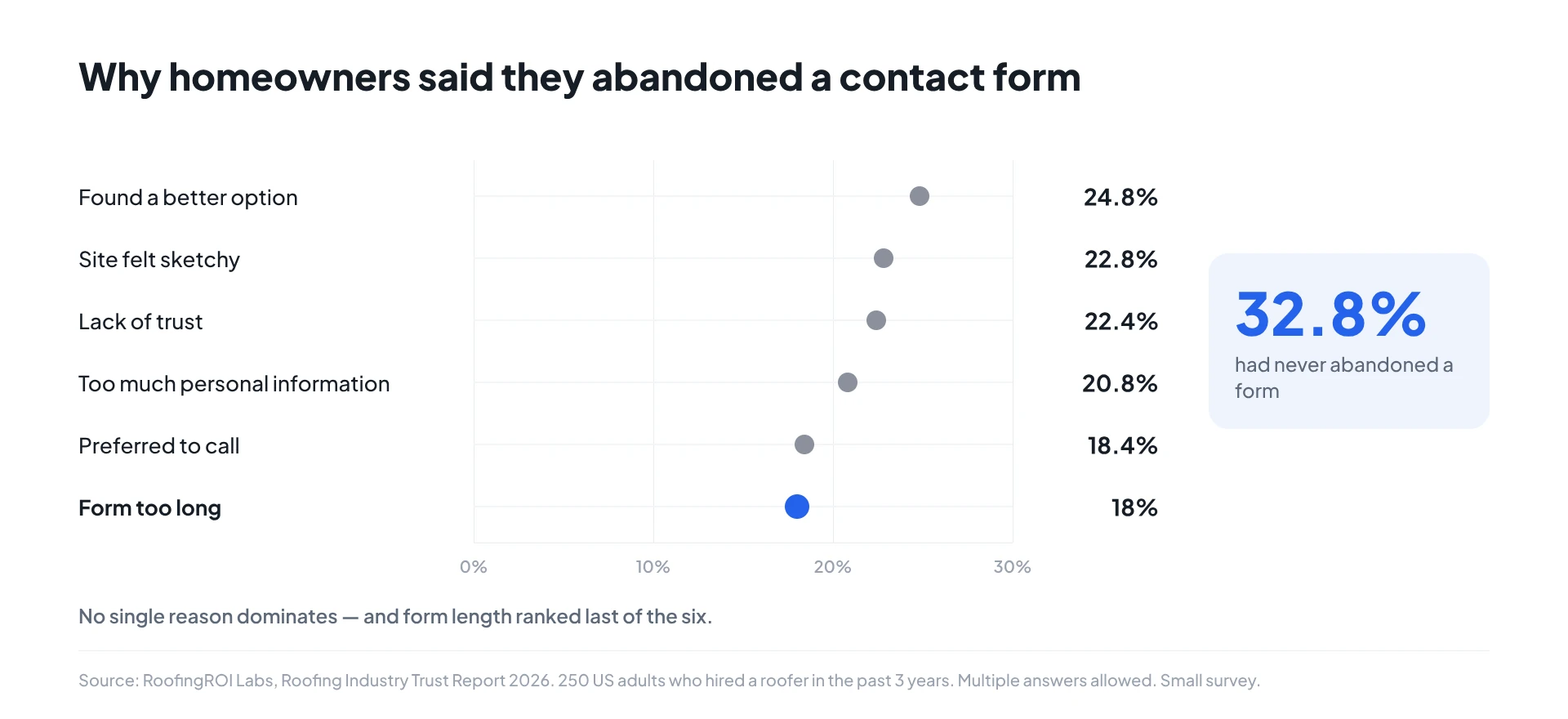
"Form too long" came last. Trust and privacy came up more often than length.
What helps is not complicated:
- Put your best reviews near the top, close to the phone number and the form.
- Show real, recent jobs, with the neighborhood or town named.
- Use a real name and face. "Mike will call you" beats "a team member will reach out."
- Show your license and insurance in plain sight.
After the request, nobody answers
This is where many roofers lose the job without ever knowing it.
In the RoofingROI survey, 80% of homeowners contacted two or more companies before deciding. 36.8% contacted two and 36% contacted three. A request to your company sits next to other roofers' replies.
When a call went unanswered, 40.8% left a voicemail and waited. But 28% called the next company right away.
There is also measured behavior, which is stronger evidence than what people say. Pied Piper ran a mystery-shop study in 2026 across 31 of the largest US home services brands, with 3,211 evaluations by phone, chat or web form. "No follow-up at all" was the most common experience, at 72%. That study covers home services in general, not only roofers, and Pied Piper sells a monitoring service. Still, it shows how often a request goes quiet.
There is no reliable number for how fast homeowners expect a reply. The surveys disagree a lot, so any single figure should be treated with care. A better rule: pick a response time you can keep, and keep it.
Picture a hail week. The crew is on a roof. Three requests come in before lunch. If nobody replies until evening, those homeowners may have talked to someone else by then. That is a made-up example, not a case study, but it is easy to test against your own phone log.
You do not need to be glued to your phone. A few automatic pieces cover most of it:
- An instant text after a request. "Got your request. Name from Company will call you by time." The homeowner knows it landed.
- An alert to your own phone. Not to an old info@ inbox checked on Fridays.
- Missed-call text-back. If you miss a call while you are up on a job, the caller automatically gets a text. It is a setting in most business phone and follow-up tools. The homeowner never sees the tool. They just get a text.
So what is the form for?
The form is the backup. It catches people who cannot call right now, like someone on a lunch break, or someone looking at a ceiling stain at 10 at night. That is worth having. It just should not carry the whole website.
Keep it simple.
Say what happens next. "Get a Free Quote" promises a price, and homeowners know a real price needs someone on the roof. It also sounds like every other roofing site. Something like "Book a Free Roof Inspection" says what they get. Add one line under it, such as "We call you by ADD REAL RESPONSE TIME to set a time." Only write that if you can keep it.
Match the reason they came. A homeowner with water coming in wants "Report a leak" or "Report storm damage" more than a quote.
Ask for little. Name, mobile number, address or zip code, and a short box for what is going on. Skip the "how did you hear about us" drop-down and the budget question.
How many fields to use is a smaller question than people think. Zuko, a form analytics company, says in a benchmark write-up (updated December 2025) that form length makes almost no difference to completion in its data. It gives no exact figure or dataset size, so do not lean hard on it. Studies disagree. Keep it short and move on to the parts that matter.
Say who sees the details. "Your details go to me and my office manager. We call once to set up a time." Only if true.
A note on reading these numbers
You will see many statistics about roofing leads. A few rules make them easier to judge:
- "Homeowners said" is not "homeowners did." Surveys capture what people say they prefer. Mystery-shop and call data capture what happened.
- Check who ran it. A company that sells call tracking, software or marketing has a reason to find that you need those things. That does not make the data wrong. It means you should check the sample and the method.
- Check the sample. 250 people is a hint. 3,000 evaluations is stronger. Neither covers every market.
- Distrust round, dramatic numbers with no source. If a stat has no year, no sample and no link, skip it.
What to fix first
If you have one hour to spend on your site, this is the order that makes sense:
- Make the phone number big, at the top, and tappable.
- Put your best reviews and a real nearby job close to it.
- Set up the reply: an instant text, an alert to your phone, and missed-call text-back.
- Then tidy the form.
Most roofers start at number 4 because it is the visible part. It is also the part with the smallest effect.
Test it in 10 minutes
Do this on your phone, not your laptop, since that is where most homeowners will see your site.
- Open your site. Can you see the phone number right away? Does tapping it start a call?
- Scroll down. Can you see reviews and real jobs without hunting?
- Fill out the form with your own name and number. What did it ask? What does the button say?
- Watch what happens after you hit send. A confirmation on screen? A text? Nothing?
- Check where the alert went. Your phone, an old inbox, the spam folder, or nowhere?
- Wait. How long until someone calls you back? If it is the next day, that is your answer.
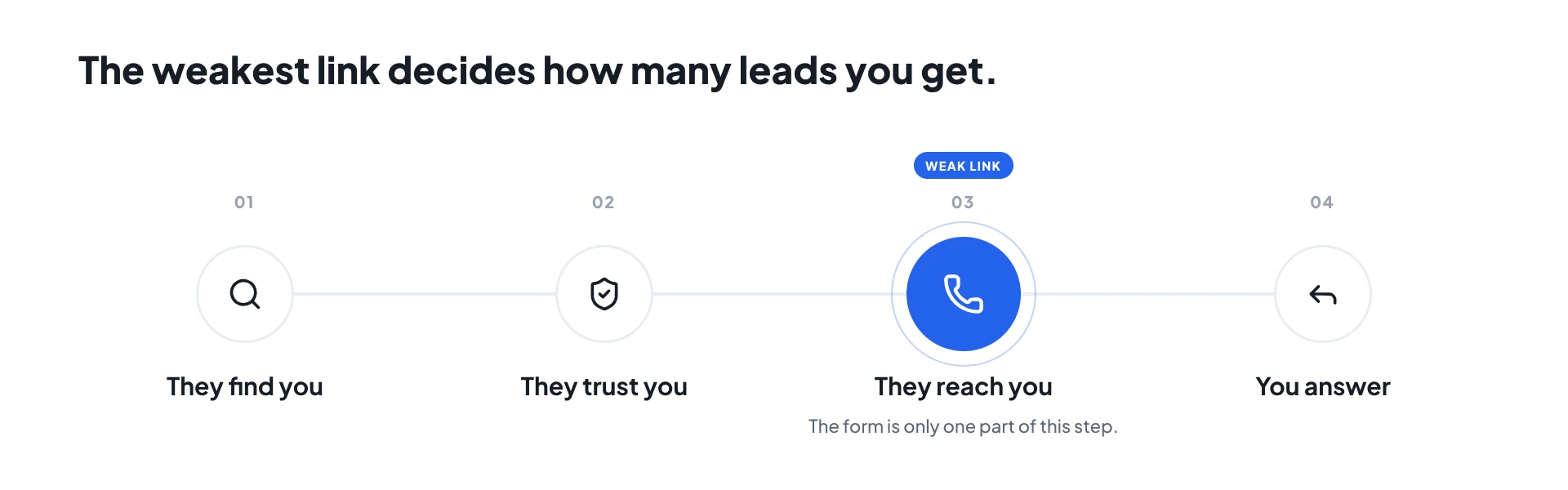
The form is one small part of a bigger chain: they find you, they trust you, they reach you, you answer. The weakest link decides how many leads you get.